TLDR
Cursor's forward deployed engineering (FDE) team partners with enterprise customers to co-build AI-assisted software factories, focusing on high-impact, project-based engagements that deliver measurable ROI. The talk emphasizes hiring 'unicorns'—engineers with both deep technical skills and customer-facing experience—and avoiding staff augmentation in favor of collaborative co-development.
Key points
- Forward deployed engineering is most valuable for customers with high digital maturity using highly customizable products, where the FDE team acts as advisors to accelerate adoption.
- The FDE role requires a blend of high technical skill and high EQ to work with diverse stakeholders from CIOs to developers.
- Cursor's FDE team works on project-based engagements scoped around strategic objectives, co-developing in the customer's codebase to drive meaningful ROI.
- The team pushes edge cases for the Cursor platform, testing new use cases across business functions like HR, finance, and supply chain.
- FDE engagements should avoid staff augmentation; instead, they involve collaborative co-development with customer teams assigned to the project.
- Founding FDE hires should be 'unicorns'—5+ years software engineers with customer-facing experience—rather than early-career professionals.
- Best practices include defining success from the start, scoping directionally with phases, involving the customer at every step, and measuring ROI by revenue increase, cost decrease, or risk mitigation.
- The FDE team structure will evolve over time, potentially splitting into more technical and more customer-facing roles, and shifting from geography-based to industry-based alignment.
Tools mentioned
- Cursor
- Cursor SDK
- Long-running cloud agents
Techniques
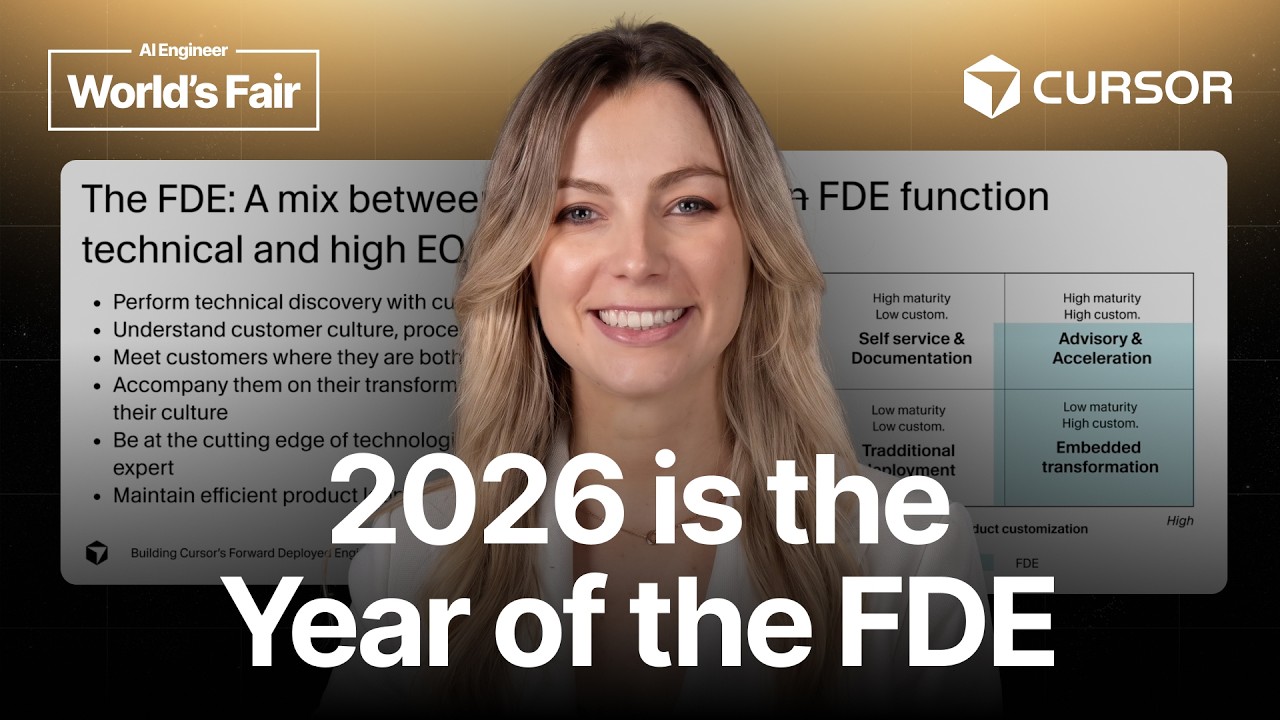
- Customer maturity and product customization matrix for determining FDE engagement
- Co-development with customer teams in their code base
- Scope directionally with phases
- Define success metrics from start
- Involve customer in every step
- Measure ROI in terms of revenue increase, cost decrease, or risk mitigation
- Leave documentation artifacts behind
Takeaways
- Determine the right FDE motion using a matrix of customer digital maturity and product customization.
- Hire 'unicorns'—highly technical engineers with customer-facing experience—for the founding FDE team.
- Focus on project-based engagements with clear ROI, avoiding staff augmentation.
- Listen to customers and be willing to pivot offerings based on their needs.
Transcript (captions)
[music] >> Hello everyone. Can you hear me okay? Fantastic. Are we having a great conference? Everyone's excited? Amazing. I would love to introduce myself. My name is Pauline Brane. I lead the forward deployment engineering team globally at Cursor. I'm super excited to share some of the learnings that we've had as a company as we build out this function. I have been doing AI deployments to enterprises for the last 10 years across consulting and I've worked in it's my third tech company. So I'm incredibly excited to share some of the learnings. I encourage the discussions. I'm incredibly passionate about the FDE function and only 20 minutes to talk about it is not nearly enough. So please catch me after I'd love to chat with you about how we're thinking about this, what we've learned, and what we want to do going forward. So a couple things about Cursor. We are an AI coding platform as you are well aware. We have incredible products that we are offering as we're helping people go from autonomous coding to asynchronous and synchronous agents all the way to an AI software factory. I'm really going to focus today on the forward deployed engineering function and I want to share some of the learnings that we've had. So I'll really strictly focus on that but always eager to talk to you about what we're doing at Cursor and what we're building. So I always hear about FDE. I'm waiting for the Forbes article that's going to say 2026 hottest job of the year is the FDE. I feel like this is the year and I really want to talk about it. If you're thinking about building an FDE for your business, for your company, what I would personally recommend you do. And the first thing is I want you to understand your customers or at least the target market that you're going after and where they are in their transformation journey. And then I want you to understand your own product. What are you offering to those folks? How customizable is it? And the reason for that is cuz I think of it on on a matrix, right? And a lot of people ask me, "Hey, is FDE like professional services? Is it the same thing as staff augmentation? What is FDE?" And I have some pretty strong opinions about where it fits and where it's not a great use of your 10X engineers to invest that time in for your customers. So, the first part is think about your digital maturity of your customer. How how mature are they? How technically advanced are they? Where are they on their transformation? And how can you actually help them for it? The second part is the product customization. Like, how configurable is your product? Is it SAS straight out of the box? You just sort of send a login? Like, for example, Teams. Is it super easy to get set up and get running by yourself? Or is it highly customizable, highly configurable for your customers? And think about that on the metric. So, if you have a customer who is really mature in their digital transformation, they have engineers, um it's a low customization on your project, I would really just say provide your product in a self-service fashion, create give great documentation, probably not a great use of your FDE motion. Same thing on your low maturity, low customization. To me, this is like a traditional SAS deployment, right? Like, I go in, deploy it. You can picture the waterfall project going through. Um not a great use of your FDE projects. Then you have customers who are really really mature and you have highly customizable products. Here, you're going to have crazy adoption, right? And I would say a lot of it should be your FDE team should be acting as advisers and help accelerate them. And then finally, you have some of your customers that are sort of further back in their transformation journey. They're learning a little bit about how to do it. They may not be able to hire or staff the folks that you you And so, they need a lot more help and here is where I think of like that embedded transformation. And then across this, that blue sort of square that you see is where I think the FTE really fits in. And for a few reasons, which is for those that are very mature, low customization, you can help them maybe extend, right? Create a couple new features, extend the application. You have that great feedback loop that you give to your product and engineering teams. But your FTE team won't be as helpful or as impactful with those folks. Same thing on high maturity, high customization, there's definitely room to help them, but they can do a lot of their work for them and you don't want to be like a solution architect, you don't want to be writing down bugs, you don't want to be, you know, updating documentation. You really want to focus on what's going to drive business for them. Same thing on the traditional deployment, maybe you can do some configuration extension. I would be very mindful that you're not doing a product 101 201 session, that you're not like holding workshops for everyone in the company to be trained on your latest SaaS software. I think that's not a good use of the FTE function personally. So then, once you've decided, "Hey, where am I in this box?" Hire accordingly, because you have to attract this talent, you have to pay them, and then you have to make sure that they are working on critical, interesting, important things. Otherwise, they're going to get bored, rightfully so, and they're going to leave because you sold them FTE that wasn't FTE in my opinion. So what is a magical unicorn that is the FTE, the forward deployed engineer? To us, it is someone incredibly technical who also has really high IQ. So what does the job entail? It entails working with all types of customers across all levels of the organizations, so CIOs, CTOs, COOs, as well as a developer, engineering managers, working with uh of transformations, VPs of AI. and so you have to be able to really quickly lead a discovery, find the right use case, understand their processes, how are they doing things today, how can you help them do things better. You have to understand their culture, how you're going to affect change, and then you have to accompany them on that digital transformation journey, right? So, you're an actor of change. Of course, you're using technology to do so, but you have to help them accompany them. I always say, if you put in the latest and greatest tech in your organization, and you don't accompany people, no one's going to use it. And then finally, as an FTE, you have to be at the cutting edge of the technological advancements. So, I don't know about you guys, but I'm you know, there's like new releases every week. We got to catch this up. You have to be curious. You have to be able to enjoy it and want to learn from it. Otherwise, this is not a fun job, let me tell you, because your customers are expecting you to be the expert, and that's super important. And then finally, you have to work very delicately between the product and engineering teams and your customers, where you want to give that feedback loop to your product team saying, "Hey, we're hearing this over and over again." Uh and the FTE team is so close to the customers, embedded in their organizations, they're going to be the first ones have a really good pulse on what we should build next as a company. So, really effective feedback loop. Uh we work very closely with our engineering and product teams. So, I want to share a little bit about what Cursor looks like uh in terms of the FTE team, what we've learned, what works for us, what doesn't. Uh so, as you know, we are an AI coding platform. A lot of our customers are incredibly [snorts] mature organizations, deeply technical buyers and users, and that has informed of who we hire and the profiles we're looking for. So, I recommend you think about who is buying your software, and how can you help them, and then match the right folks to hire in your FTE team. So, for us, it is project-based, highly impactful projects. So, I usually would like to work with the economic buyer or a very senior champion within my accounts to make sure that we are scoping something that is a strategic objective for the company, right? That is going to drive meaningful ROI for the company, and that they have the resourcing that they're going to put on this project. Because you're going to need to be working with them side by side. You're going to need to get access to their systems cuz we develop on top of their code base. You're going to need to affect change, so you're going to need to have, of course, the top-down support to do so. And you're going to make sure that you're working on something really meaningful that when you walk away at the end of the engagements, and we in our case have deployed cloud agents, long-running agents, we've deployed automations, we've built applications on top of our Cursor SDK, that when we walk away, it is a strict ROI for them. That means they're not going to turn things off when we leave, right? Because that's part of the FTE project. We want to make sure that we're affecting change and that we're building things that matter to them. Meaningful return on investment. We also some cool things is we push the edge cases for the Cursor platform. So, as we get really cool use cases that are a little bit outside of the software development life cycle, the FTE team to me is the tip of the spear that is going to test out these new use cases with customers. So, we have incredible folks working with us on, "Hey, how do I help across my HR team? Uh my finance team? My supply chain team? My e-commerce team?" Right? Working with retailers, financial banks. How do I do asset management better? And as we're pushing the the edge use cases for Cursor, we're getting more and more momentum on how we can help you do other things not just within the software development life cycle, which is super important, but also across your entire company. We work in co-development with customer teams in their code base. This is where you have to be really careful that you end up uh not doing staff augmentation. So, if anyone says, uh "Yeah, you have to do this. Uh we're understaffed." Red flag for me personally. I get a little antsy on those phone calls. I'm like, "Ooh, I don't think this is the right case for us." And so, you want to make sure that you're driving something meaningful that they're going to put resources towards and that you're going to work in collaboration. So, my trick is I just ask for who are the people we're going to work with. That's great. I'll be We'd love to partner with you on this use case. We love to build long-running agents to automate your call center ticketing system. Who will be the working team? So, super important to get that. And then finally, working between our engineering and our product teams to influence the road map um and our customers. So, let them know new things are coming that are going to all of a sudden enable use cases we couldn't do before. And that's the beauty of it is we can actually go and solve more things at scale very quickly. I would recommend you have a mission of the FTE. I'll offer you mine. This is the Cursor FTE mission. Uh we partner with your organization to co-design and co-build your AI software factory. We transform how you design, develop, and maintain software across your entire life cycle. I would just encourage that you have one. It's very clear to the customer what you're trying to drive. It's clear to your team of what we should focus on. And it helps our team members think, "Hey, when I'm hearing this project that sounds like staff augmentation, I don't feel like I'm doing that towards our mission." So, that's ours. I offer you your own. What does the team structure at uh Cursor look like for the FTE is we are highly technical, highly experienced profiles. For the beginning, it makes sense for you to hire what I call unicorns. So, we hire 5 plus years software engineers. We don't hire out of school. We don't hire early career professionals at this moment. Once we grow the team bigger, we will. And so I welcome those folks that are reaching out to us. For the first set of founding for deployed engineers, we are hiring very technical folks with customer-facing experience. Over time, we will split the role, so we'll have folks that are a little bit less technical, more customer-facing, but still with technical aptitude and vice versa. Those are highly technical folks who perhaps are not as customer-ready, but have the aptitude to learn it. We have a matrix organization. We are ready to pivot in any way, shape, or form. That will happen. We are geography-based for now, but at some point we will likely mature to industries because when you talk to an industry and you don't use their lingo, you immediately lose credibility. So if you talk to a bank and you're not talking about payment systems, if you're not talking about asset management, risk, you kind of lost them. And so you really have to have that industry knowledge. And then finally, across our product areas, we really want to focus on having the right SMEs who then become the experts. So for example, we have someone on the team who is the expert on our long-running cloud agents. We have someone who's an expert on the cursor SDK. And other team members can come in on their projects and say, "Hey, I need to pull in this person because they're important." So for us, we have folks phenomenal folks from Spotify, from Rippling, from Palantir, from a lot of organizations where we have found that we get the best people because they are incredibly excited to work with customers and they have the aptitude to do so. And then finally, we will change the roles and the structure over time. One thing we always joke about on my team is what we're doing today is not what we're going to do 6 months from now. We won't be hiring for the same profiles. We'll have changed. New products will have come out. Our customers will have changed in their journey. Here are some best practices. By the way, we We in no way perfect. I have done this for 10 years. I've made a ton of mistakes. Um learn quickly and pivot is my recommendation. Just learn from it. Try out a project with a customer. You might fail. That's okay. Right? Just actually try it out. You will learn so much more than if you're just kind of waiting and planning. I don't recommend doing that. Listen to your customers. I'll give you a really concrete example. Um I was not planning on offering this as an FTE offering. I've heard it six or seven times now and so I'm going to create one. The question I get asked is, "Hey Pauline, how do I change my organization now that we have these amazing tools? How do I capture value? So, who do I hire? What are the job description? Um how do I rearrange the teams? Right? How do I change the ways of working together, the processes to actually go capture this value?" Not something I was going to offer. Um so, we actually might be offering that very soon and we'll hire the right team to actually support that. So, listen to your customers and adopt accordingly. Uh work with partner organizations. You can always benefit from uh system integrators and consultings. One, they really know your customers. They've been in there for a while. They have great relationships. Two, there's a lot of stuff that I just frankly don't want to do and let's have the SIs do it. So, for example, I'm not really that great at change management. Not a fan favorite. Um and so, with a lot of that can be actually accompanied with partners. Same thing on rolling out uh existing products that we're really good at and we've done this a bunch across Telco. We've done it a bunch across healthcare life sciences. You can roll this out and increase the reach of your organizations. So, partner with your your uh system integrators and your consultants so they can go do that at scale and broaden in your reach. Talked about this already. Um don't be afraid to say no. This one's a hot topic. Uh I have customers who'll say, "I want to do this." And I will say, "Ooh, Cursor is not the right tool for that." Couple of reasons. One is you build credibility by being very honest about where our applications and our products and our platform are the right tools and where they're not. So, you earn a lot of um sort of feedback from that because they'll say, "Actually, I have this other use case now that I trust you as a trusted partner." And then two, of course, if if it doesn't go well, then you're on the hook for that. So, I would recommend be very specific in the use cases you're solving. And then finally, attract and pay the right talent. So, just make sure that you are hiring the right profile for what you want to deliver on. Very dependent on you. We talked about this at the beginning. And make sure that you are attracting them, paying them, keeping them motivated. So, very important, especially in this you know, war for talent that we're currently in. Here are the tips for running through FTE. Uh check you're solving the right problem. It seems easy. It's actually really not. Uh sometimes you're you're solving sort of a symptom, not the right problem. Sometimes you're talking to the wrong person who thinks they have the right problem, but they may not. So, just always inquire, ask questions, um who's responsible for this? Can I talk to them? Right? I really like to talk to the person responsible for the process, the workflow, the department, whatever we're trying to solve for. Define success from the start. If I accomplish this, will this be successful for you? If I automate this process from start to finish and then now takes 20 minutes instead of 3 hours, which is current baseline, is that sufficient for you? Does that measure success? Yes, great. Um I I have a lot of opinions about scope. So, I think that you cannot just do like, "Hey, take two FTEs for 6 months, do whatever you want with them." I think that's a recipe for failure. What I would recommend is that you instead are trying to solve a problem and you establish what you're going to do to solve that problem. So, we want to automate this process from our start to finish using long-running agents. Long running agents are going to grab data from these. They're going to make these decisions. They're going to involve these people in the feedback loop, and they're going to go and reduce our mean time to resolution. They're going to go and automate this process from start to finish. They're going to reduce in terms of claims management the time to answer a customer on their claim. Whatever the KPIs that we're trying to drive, keep the scope directional. We're going to do phase one and two. We're going to automate these things. We're going to set up these agents for you. It's going to take 6 weeks. We're going to do as much or as little as we can. The reason for that is I do not know the customer processes. I haven't really seen their data. I haven't seen their systems, right? And so I'm a little bit on the hook if it takes more than 6 weeks or less. That's the first part. The second part is from a customer perspective, we're going to learn a lot, and they're going to maybe want to pivot once we learn something. And having something that's directional where I can go and sort of pivot based on the the learnings I have, customers actually really appreciate that in the end. And so that would be my recommendation. Involve the customer in every step step. Scoping, actually building and designing the solution, implementation, doing the human in the loop validation, looking at baseline versus the results, identifying the ROI we're driving. They should own that. We are supporting them in this journey, right? We are still hands-on keyboard. We are still configuring. We are still developing on top of their code base, but make sure you're not doing it alone. If you're doing it alone in their office in a little cubicle, we have a problem. Okay? Please raise your hand if that's the case. We need to solve something. Finally, measure success. Did were we successful? I said that we could do this from 3 hours to 20 minutes. Did we get close? If not, why not? What can we do about it? And then finally, what's the return on investment? You want to over communicate that. Right? I had a someone mentioning to me that an agent was running was costing $2,000 per day and I said, "Well, what was the agent doing?" And he explained it to me and I said, "Hey, that sounds like you're actually reducing costs to send the right person to go fix this equipment. Would that not be worth $2,000 a day?" And he said, "Absolutely, but I never measured it this way." So, always think about what's the ROI you're driving. It's always three things, super simple. Am I increasing revenue? Am I decreasing costs? Or am I mitigating risks? That's it. Every company, as complex as they are, that's what they care about. Which one are you doing? Could be all three, which is fantastic, but at least one of them. Finally, leave your documentation artifacts behind so that you can help them. So, I'll 32-seconds wrap up. Build the right FTE motion for your company. Learn, pivot, and scale, super important. And then create this amazing culture where people want to be a part of it. They want to learn. They want to do their best work. And give them the chance to do so. And so, the the thing I'll leave you with is um you know, I always say hire A players, hire A players, B players hire C players. So, just be very mindful of that. Make sure that you are hiring the right talent for your organization, for your customers, and you're keeping them motivated. Thank you, everyone. >> [music]
Jobs for this video
| Stage | Status | Attempts | Last error | Updated |
|---|---|---|---|---|
| summarize | done | 0 | — | 2026-07-14 22:05:57.781187+00:00 |
| transcript | done | 0 | — | 2026-07-14 22:05:41.632169+00:00 |
| metadata | done | 0 | — | 2026-07-14 22:03:29.164558+00:00 |