TLDR
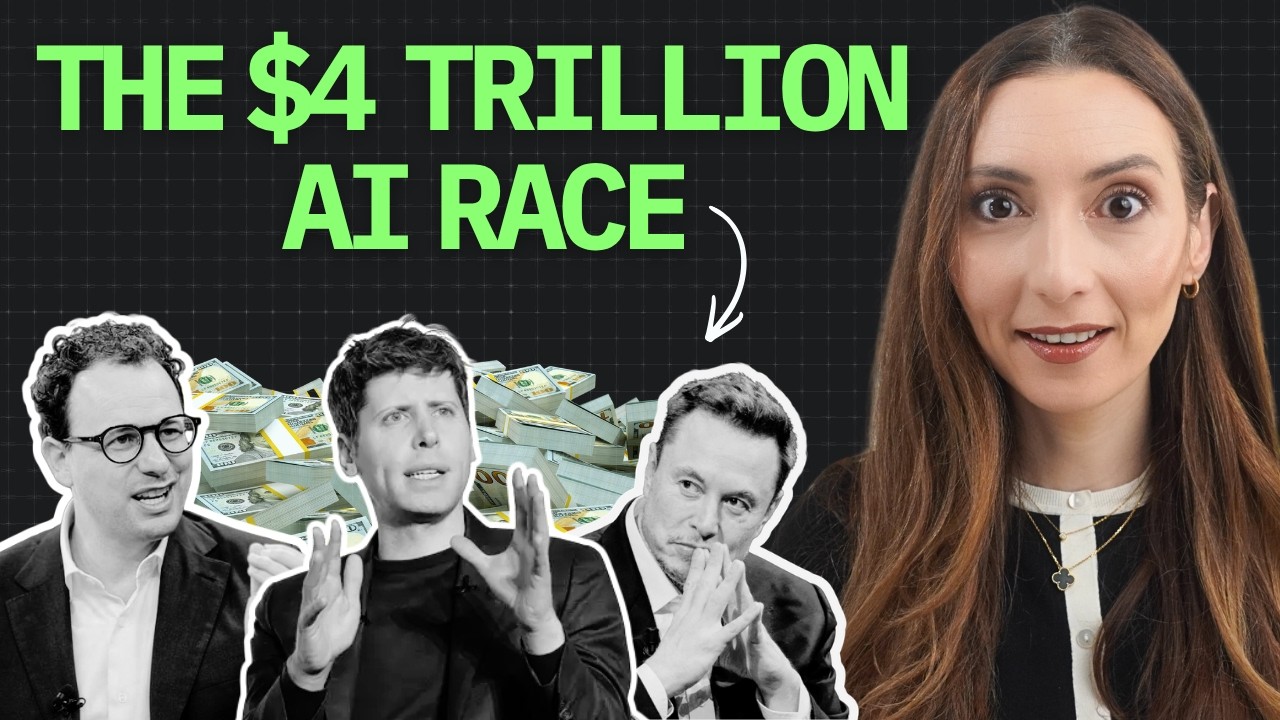
Three major AI companies (SpaceX, Anthropic, OpenAI) are filing for IPOs at a combined ~$4 trillion valuation, burning cash to subsidize access to powerful AI tools before going public. The next 12 months offer a rare window for founders and solopreneurs to build agent-powered businesses on cheap infrastructure before prices rise. Key shifts include the temporary shutdown of Claude 3 due to national security concerns, a drop in organic search click-through rates from AI overviews, and the rise of vibe coding for rapid prototyping.
Key points
- SpaceX, Anthropic, and OpenAI all filed for IPO within 60 days, with a combined valuation near $4 trillion, despite none being profitable yet.
- Claude 3 launched with extraordinary performance but was shut down after three days due to US government export controls citing cyber weapon risks.
- AI overviews now appear in 58% of Google searches, causing organic click-through rates for informational queries to drop by up to 61%.
- Google launched Gemini Spark and Meta rolled out business agents, signaling the shift from AI assistants to autonomous AI agents.
- Vibe coding has enabled 63% of users who are not developers to ship working apps using plain language AI tools like Lovable and Cursor.
- Stanford's 2026 AI Index reports global corporate AI investment hit $581 billion in 2025, up 130% year-over-year, yet agent deployment remains in single digits.
- AI agents improved from 12% to 66% success on real-world computer tasks between 2024 and 2026, driving the launch of multiple agent products.
- The Stanford report highlights the jagged frontier: AI outperforms humans in some areas but fails at basic tasks like reading an analog clock.
Tools mentioned
- Claude 3
- Gemini Spark
- Meta Business Agent
- Perplexity
- Lovable
- Cursor
Techniques
- Vibe coding
- Agent-powered business automation
- Building an email list to counter AI overview traffic loss
- Human-in-the-loop review for AI-generated code in production
Takeaways
- The next 12 months are the window to build on cheap, subsidized AI infrastructure before prices rise after IPOs.
- Stop creating content that AI can summarize; focus on un-copyable human experience, case studies, and proprietary insights.
- Use vibe coding to prototype ideas fast, but always have a senior engineer review code for customer-facing apps.
- The agentic wave is just beginning—most businesses haven't deployed autonomous AI, creating opportunity for early movers.
Transcript (captions)
In the last 60 days, three of the most powerful companies in the world filed for IPO. SpaceX, Anthropic, and OpenAI. Combined valuation close to $4 trillion with a T. But here's the thing, none of them are selling phones, none of them are selling ads, and none of them are selling rockets, shockingly I know. They are all betting with trillions of dollars that the next decade of human productivity runs through AI. And if you're a small business owner or a solopreneur watching this right now, that bet is probably the [music] most important thing that has happened to your business this year. Because the infrastructure they are building, we get to rent it for $20 a month. So, continue watching this video because this is your briefing. The last 60 days of AI news [music] filtered for what actually makes a difference to you, the founder, the solopreneur, the person building something real. So, let's get into it, okay? [music] I'm going to cover five big, massive, mega gigantic changes >> [music] >> that happened between May and June 2026. Each one changes something about how you should be running your business right [music] now. We're talking about the most dramatic AI model launch and shutdown [music] in history. The trillion-dollar IPO race and what it means to the cost of doing business for all of us. Silent death of the traditional content marketing playbook. The rise of [music] AI agents that work while you sleep. And the one update that most people completely missed. So, by the end of this, you will have a pretty clear picture of where the leverage is moving and exactly how to position yourself on the right side of it. So, let's start with the wildest story of the month, and I mean that >> [music] >> totally literally. On June 9th, Anthropic released Claude 3. I remember it because we were in a call with the founders. Their most powerful model yet came [music] out, and the reviews from early testers were unlike anything that was [music] released or shipped before. Clearly unlike anything that I have seen. Stripe reported that it compressed [music] months of engineering work into a single day. A 50 million line code base migration, the kind [music] of a project that would have taken a full team and two to three months was done in [music] 24 hours. Reading everywhere you would have seen developers building entire apps in a single afternoon and lawyers using it for contract analysis at level that matched [music] senior associates. Scientists were running autonomous research workflows. >> [music] >> And then, three days later, it was gone. The US government issued an export control directive, >> [music] >> which forced Anthropic to shut down access for all foreign nationals globally, citing national security concerns. Their specific worry was that the model was so capable at finding and exploiting software vulnerabilities that it could function as [music] a cyber weapon in the wrong hands. Now, most people heard the story and thought, "Ooh, scary. AI [music] is getting really dangerous." But I want you to hear it through a different lens. When a government steps in because an AI model is too powerful to be allowed to run freely, that's not a warning about danger. That is a proof of concept. That is the clearest signal that we have ever received that these tools have crossed the threshold from smart chatbot assistant to senior-level executor. And if you understand this, you're probably one of the few ones building a one-person business with the leverage of a 20-person team. If you don't, you're treating AI like a fancy search engine or spell checker or meme designer, I don't know. Now, let's talk about the money, because the money tells us everything, including the parts that nobody wants to say out loud, but I'm [music] going to. So, in June, just a few days ago, actually, SpaceX went public into the largest IPO in history. 75 billion raised, 1.75 trillion valuation. Anthropic filed for its own IPO days later at a 965 billion dollar valuation. [music] And on June 8th, OpenAI submitted its own confidential S-1 to SEC targeting a public listing as early as I think September 2026 at over a trillion dollars. >> [music] >> Three companies filing for public markets in the same month with combined valuation of 4 [music] trillion dollars. Now, most coverage of this story sounds like a celebration. Yay, AI is winning. The future is here. Invest now. Become rich. But I want to give you the honest version because the honest version is actually probably more useful to you as a founder. So, here's the thing that you need to see. These companies are not filing for IPO because they're overflowing with profit. They're filing because they're burning through cash at a scale that private investors [music] can no longer sustain alone. In fact, if you look closely, AI is projected to lose somewhere between 14 and 26 billion >> [music] >> in 2026. However, at the same time, it has committed 1.4 trillion to data center infrastructure and does not expect to be cash flow positive until 2030. Anthropic is paying 1.25 [music] billion dollars per month just for the compute that it needs to run its models. SpaceX's AI division lost 6.4 billion last year. >> [music] >> In fact, Anthropic's own president said it very clearly. It is a very capital intensive business. The public market is very well suited for that because their private investors no longer are. So, what does that mean? They need money, our money. [music] The public markets are the only pool of capital large enough to fund the next phase. Now, some analysts are already drawing comparisons to 1999, the dot-com bubble. Companies with incredible technology, real promise, and no clear path to profit going public at astronomical valuations right at the peak of public enthusiasm. So, why am I telling you this? Because this is exactly where the wealth creation opportunity for all of us lives, and why the window in the next 12 months, not the next 10 years, is wide open. So, here's the dynamic that I choose to look at. These companies are in a race. They're burning billions to build infrastructure and keep prices artificially low to win market share before their IPOs. They need adoption numbers, [music] right? They need revenue growth stories. They are subsidizing your access to the most powerful technology ever built because their valuations depend on it. Right now, you can access senior-level AI executives, the kind that would cost a team of 10 people 2 years ago or 4 years ago, and hundreds of thousands of dollars most likely, for $20 a month. Clearly, that is not the natural price. That is a subsidized price, a price that exists because these companies need to show growth before they go public. But once they're public, once they're accountable to shareholders every quarter, once the pressure to become profitable kicks in, prices probably will rise because the subsidy ends. Think about what happened after the dot-com bubble. The companies that built real businesses on top of cheap internet infrastructure, think Amazon, Google, Salesforce, they survived and dominated. But the ones who waited until the infrastructure was mature and expensive, ended up paying full price and competed against people who had a 5-year head start. So, that's why I'm saying that the next 12 months are our dot-com moment. The infrastructure is still cheap, the tools are powerful, and the window is wide open. The question is not whether AI will create wealth. It will. Stanford AI index puts global corporate AI investment at 581 billion last year, and that is up 130% in a single year. Instead, the question is whether you are building on top of this wave [music] while the price is still subsidized or whether you're waiting until it's expensive >> [music] >> and crowded. Clearly, the early movers, like always, are already pulling ahead, and this is where [music] the leverage is shifting. So, make up your mind and take action. Now, let's talk about what that infrastructure is actually producing because the biggest shift of the last 60 days [music] is not a new model or aside from that, I think it's more so a new [music] category of tool entirely. We have moved from AI as an assistant to AI [music] as an agent. At Google I/O, and I did a full dedicated breakdown of this, which, if I remember, I'm going to link here, if not, in the description, Google announced Gemini Spark. It's not a chatbot, it's a 24/7 personal AI agent that runs in the cloud [music] even when the laptop is closed. Triages emails, manages your calendar, drafts your documents, and executes multi-step tasks [music] under your direction. Also, Meta rolled out their business agent globally across WhatsApp, Messenger, and Instagram. Over a million businesses are already using it, and you can set it up in minutes, and it will answer customer questions, [music] qualify leads, make product recommendations, and close sales around the clock in your customer's local language. So, here is the analogy that I want you to take away. In 2026, hiring a human to handle repetitive administrative tasks is basically like hiring someone to do long division on paper. >> [music] >> I mean, it's not wrong, it just misses the entire leverage altogether. Now, I know that with your expertise in your niche, [music] your time is your most valuable asset, but even the best founders have those energy-draining tasks, [music] the ones that pull you out of your zone of genius. Agentic AI can take those [music] off your plate. The early movers are already running with an output of 5 to 10% business, even if [music] they're a solo founder. Now, I need to give you a heads-up about something that is already hitting small businesses, [music] especially, pretty hard, and most people have not connected the dots yet. Google has officially rolled out AI overviews [music] to over a billion users. What that means is that when someone searches a question, Gemini summarizes the answer and puts it right at the top of the page before AI website [music] results. The data is in and AI overviews now appear in 58% of all searches. [music] For informational queries, like your how-to articles or your what is [music] explainers or your best practices guides, organic click-through rates have dropped by up to 61%. So, if your business has been relying on content marketing to generate top of the funnel traffic, Google is now intercepting that [music] before your audience ever reaches your site. What that means is that the cost of waiting to adapt to this strategy is only going up, and I'm going to make a few videos [music] and go in significant depth about this, but I wanted to bring it up because I think it's important. What I want you to take away is that this is where [music] the opportunity lives. AI can summarize information. It cannot replicate experience, [music] however. It cannot share the specific case study where you found [music] a 30,000 accounting error for a client. It cannot reproduce your proprietary data, your practitioner insights, or your unique, genuine point of view. >> [music] >> So, the pivot here is this. Stop creating content that an AI can easily summarize and start creating content that builds trust [music] through an un-copyable human experience. I don't even know if that's a word, but I think you understand what I mean. Think original research, >> [music] >> strong opinions, specific client stories, detailed case studies, and critically, start moving your audience off rented land. Build your email list because Google can change its algorithm overnight. Your email list belongs to you. Now, for the fifth shift. And this one is personal for a lot of you because I know many of you have had a business idea sitting in your head for years and held back by one thing. You don't know how to code. That excuse is proven with data to be dead. By 2026, 90% of developers are using AI coding tools. But here is the stat that matters significantly more than that. 63% of Vibe Coding users are not developers at all. They are entrepreneurs, product managers, small business owners who are shipping real working apps by describing what they want in plain language and letting AI generate the code. You look at it, Lovable, the AI app builder, hit 100 million in annual recurring revenue just [music] 8 months after launch. Cursor, the AI coding tool, is now valued at 29 billion. The Vibe Coding is estimated to be 4.7 billion this year, projected to reach 12 billion by 2027. So, the technical barrier to building a software product pretty much collapsed. You can now go from idea to working app in a weekend. You don't need a co-founder, you don't need an agency, you don't need to spend months and months and months developing. But I want to give you the honest version here, too, because this is where a lot of people get burned. Meter controlled study put experienced developers on real code bases with and without AI tools. The developers predicted they would be 24% faster, but they came out 19% [music] slower. And what I found to be wild was that even after the study, they still believed they had [music] been faster. A Stanford trial found that developers using AI wrote less secure code than developers without AI, while reporting higher confidence in the security of their work. So, what does this mean for you, for me, as non-technical founders? It means that Vibe Coding is >> [music] >> fantastic for building and validating ideas fast. You want to test whether a product has legs, build a prototype in a weekend and put it in front of real users. That is where the leverage is massive. However, if you are building something customer-facing that handles real data, real payments, real users, you do need a human with judgment reviewing [music] what the AI generates before it ships. The AI is a brilliant junior developer. You still need a senior engineer in the loop for anything that matters. The opportunity is real, the tools are here, just go in with your eyes open. Now, let me bring this all together because everything I've covered today is connected by one thread, and I want to make that thread explicit so that it's clear to everyone. Stanford University publishes what is widely considered the most rigorous annual audit of where AI actually stands. The 2026 edition came out in April. It was 400 pages, and I'm going to give you the gist so you don't have to read it. So, here's what [music] it says. Global corporate AI investment hit 581 billion in 2025. It was up 130% in a single year, more than double the previous record. The year before that, it was 253 billion. This is not a trend that is slowing down. It is a trend that is clearly accelerating. AI agents, the kind that actually execute tasks autonomously, not [music] just answer questions, went from 12% success rate on real-world computer tasks in 2024 to 66% [music] in 2026. And that is a fivefold improvement. And it's why Gemini Spark and Perplexity and Meta all launched in the same [music] 60-day window. The capability finally caught up with the vision. Now, generative AI has been adopted by 53% of the global population within 3 years of becoming widely available. [music] For context, the internet took over a decade to reach that level. The smartphone took 7 years. AI is moving faster than any technology in human history. You don't need me to tell you that. But, here is the number that should stop you in your tracks. 88% of organizations now use AI in some form. But, agent deployment, AI that actually does work autonomously, is still in single digits across [music] every business function. That gap is your opportunity. The adoption wave has happened. The agentic wave is just beginning. The founders who build [music] agent-powered businesses in the next 12 months are not late. They are exactly in the right phase. But, the Stanford report also surfaces something that I need you to hold on to. They call it the jagged frontier. In the same year that AI scored a gold medal at the [music] International Mathematical Olympiad, the best AI models in the world could only read an analog clock correctly about 50% of the time. Compared to 90% for humans. >> [music] >> Basically, it's a superhuman in some places and is below average in others. Which means that your job is trust AI blindly. Your job is to know where the edge is sharp and where it's not. That is the skill that creates wealth in this era, not just using AI. Knowing where to deploy it and where your judgment, specifically human judgment, still wins. So, I made a video about that, which I'm going to link here as well as in the description down below for you to be able to apply exactly [music] this judgment. But, hopefully you see it. The next 12 months are very significant. Not because AI is guaranteed to succeed, but because we are in the exact window where the infrastructure is cheap still. The tools are powerful, the agents are just becoming capable, and most businesses have not yet figured out how to use any of it properly. So, if you want to figure out how to do that yourself, you are always more than welcome to join us in our free [music] school community. It is called the AI Business Trailblazers Hive. We have loads of free challenges. [music] We have calls every 2 weeks where you can come and ask your questions and you'll just be surrounded by people who are on the exact same [music] path as you are, so you can learn from one another. If you do need more hand-holding, we have the Founders Hive, which is our paid school community, and there we have a very clear 90-day path for you to [music] start or grow your business with AI, and we are also launching the Claude course, which probably by the time you're watching this is already live. So, if you want to learn how to use Claude to automate your business, then come and join us in the community. Until next time, thank you so so much for watching. Like this video if you did. Be sure to subscribe if you haven't done so. Share this video with anyone in your circle of friends or family or co-workers who you think needs to know what's going on in the AI space. And until next time, I suggest you go ahead and watch this video here, and I'll see you there. Bye.
Jobs for this video
| Stage | Status | Attempts | Last error | Updated |
|---|---|---|---|---|
| summarize | done | 0 | — | 2026-07-02 22:06:05.124336+00:00 |
| transcript | done | 0 | — | 2026-07-02 22:04:39.231078+00:00 |
| metadata | done | 0 | — | 2026-07-02 22:04:22.176435+00:00 |